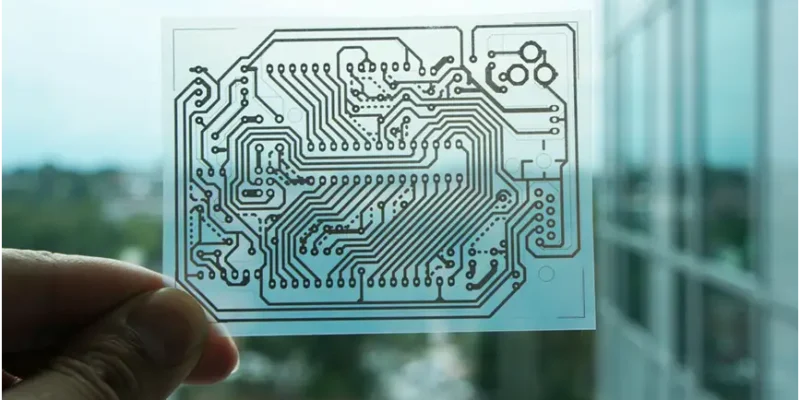
In today’s world, where electronic devices are increasingly pursuing thinness, personalization, and intelligence, traditional PCBs can no longer meet the demands of innovative products—whether it’s foldable smartphones, wearable devices that conform to the human body, or transparent displays. Behind all these breakthroughs lies a new type of circuit board: the transparent flexible PCB.
It challenges the conventional idea that circuit boards must be opaque and rigid, perfectly combining transparency and flexibility. This technology has become the core medium connecting electronic components to innovative product forms, quietly transforming everything from consumer electronics to medical, automotive, and architectural applications.
Many people hear the term “transparent flexible PCB” for the first time and ask: how can a circuit board be both transparent and bendable? How does it differ from common FR-4 rigid PCBs or standard flexible PCB? Transparent flexible PCB isn’t just “made transparent”—it’s a full innovation from substrate to conductive layer to manufacturing process. It combines optical transparency, mechanical flexibility, and electrical performance into a single, advanced circuit carrier.
This article will guide you through everything you need to know about transparent flexible PCBs—from definitions, structure, and materials, to manufacturing processes, applications, key parameters, industry challenges, and future trends—helping you unlock the secrets of these “invisible circuits.”
What Exactly Is a Transparent Flexible PCB?
Transparent flexible PCB, or Transparent Flexible Printed Circuit Board (TFPCB), is a PCB made with transparent, flexible insulating materials as the substrate, combined with transparent conductive layers and processed using specialized manufacturing techniques. These boards can bend, fold, and twist freely while maintaining high light transmittance.
The technology represents a double breakthrough:
- Breaking the opacity limitation of traditional PCBs: Light transmittance typically exceeds 85%, and some high-end products approach 95%, achieving “invisible circuits” that don’t block internal components or external visuals.
- Breaking the rigidity limitation: Unlike rigid PCBs, transparent flexible PCBs can bend and fold repeatedly without damaging the circuit, with minimum bending radii as small as 0.1 mm, accommodating curved or irregular surfaces.
Two concepts need clear distinction:
- Transparent flexible PCB ≠ Standard flexible FPC: Standard flexible FPCs (usually PI-based) are typically yellow, black, or white and offer only flexibility. Transparent flexible PCBs maintain flexibility while prioritizing transparency, using transparent substrates and conductive layers.
- Transparent flexible PCB ≠ Transparent rigid PCB: Transparent rigid PCBs (like glass-based boards) offer high light transmittance but lack flexibility, suitable only for fixed optical applications. Transparent flexible PCBs combine transparency and flexibility, making them suitable for dynamic applications.
In short, transparent flexible PCBs are “bendable, transparent, and conductive” invisible circuits, addressing the transparency limitations of FPCs and the rigidity limitations of transparent rigid PCBs, serving as the backbone of high-end, innovative electronic devices.
Key Components of a Transparent Flexible PCB
Transparent Substrate Layer (The Foundation)
The substrate is the backbone of a transparent flexible PCB, determining transparency, flexibility, heat resistance, and mechanical strength. Unlike traditional FR-4 boards, which are opaque and rigid, transparent flexible PCBs require substrates that are transparent, flexible, insulating, and heat-resistant.
In addition, the choice of substrate also directly impacts PCB assembly, as flexible and transparent materials require specialized handling, precise component placement, and low-temperature soldering techniques to avoid damage during the assembly process.
The four main substrates are:
- PET (Polyethylene Terephthalate): Most common and cost-effective, with over 92% light transmittance, excellent flexibility, glass transition temperature around 80 ° Ideal for mid- to low-end consumer electronics and standard transparent displays. PET is widely used due to low cost and easy processing.
- PI (Polyimide): High-end option, 85–90% transparency, excellent flexibility, can withstand 100,000+ fold cycles, short-term high temperature up to 400 °C, long-term operation from -40 °C to 125 ° Suitable for high-performance consumer electronics, medical devices, aerospace. Higher cost and more complex processing.
- PC (Polycarbonate): Similar light transmittance as PET (≈90%), high impact resistance, good flexibility, but higher moisture absorption (~0.4%), often requires surface coating. Suitable for outdoor displays and wearable device housings.
- PMMA (Acrylic): Extremely high light transmittance (92–95%), excellent optical clarity, but lower flexibility and brittle. Used where transparency is critical and bending is minimal, such as display panels or optical sensors.
High-end flex PCB substrate materials like LCP (Liquid Crystal Polymer) are also used for thin, high-frequency transparent flexible PCBs, offering chemical resistance and heat tolerance for compact, high-end applications.
Transparent Conductive Layer (The Electrical Core)
The conductive layer provides electrical functionality and determines transparency. Traditional copper layers are opaque, so transparent conductive materials are used:
- ITO (Indium Tin Oxide): Mature, widely used, >95% transparency, good conductivity (sheet resistance ~10 Ω/sq). Ideal for static displays and touch panels but brittle—resistance rises sharply when bent below 5 mm radius.
- Silver Nanowires (Ag NWs): Flexible, transparent (~95%), bends below 1 mm radius without conductivity loss. Suitable for foldable smartphones and wearables. Needs protective layers to prevent silver migration in high-temp/humidity environments.
- Graphene: Ultra-thin, highly transparent (>97%), excellent flexibility and conductivity, wear and corrosion-resistant. Used in high-end transparent TVs and other premium products. Complex processing limits mass production.
- Metal Mesh:>90% transparency, good conductivity, flexible, but line width must be <5 μm to avoid moiré Suitable for high-precision touch modules and displays.
Conductive polymers like PEDOT are also used in low-power or disposable electronics, such as flexible sensors or single-use medical devices.
TFPCB vs. Rigid PCB vs. FPCB
| Comparison Dimension | TFPCB | Rigid PCB (FR-4) | FPCB (PI/PET) |
| Core substrate | transparent PET, PI, PC, PMMA | opaque FR-4 (fiberglass epoxy) | opaque PI, PET (mostly yellow or black) |
| Conductive layer | transparent ITO, silver nanowires, graphene | opaque copper foil | opaque copper foil |
| Transparency | high (85%-95%), allows “invisible” circuits | none (0%) | very low (0%-5%) |
| Flexibility | excellent, can bend/fold repeatedly, bend radius 0.1-5mm | none, rigid | good, bend/foldable, bend radius 0.5-10mm |
| Heat resistance | medium to excellent (PET: -25°C to 75°C; PI: -40°C to 125°C) | excellent (-55°C to 150°C) | medium to excellent (PET: -25°C to 75°C; PI: -40°C to 125°C) |
| Manufacturing complexity | high, requires precise control of transparency, adhesion, and conductivity | medium | medium |
| Typical applications | foldable phones, transparent displays, wearable electronics, medical devices | motherboards, power electronics, standard industrial PCBs | wearable electronics, flexible sensors, general flexible circuits |
Summary
Transparent flexible PCBs are no longer just a concept—they are transforming how electronics are designed and integrated. By combining bendability, transparency, and conductivity, they allow engineers to:
- Create foldable and wearable devices without visible circuitry.
- Maintain optical clarity in displays, medical devices, and transparent electronics.
- Adapt circuits to curved or irregular surfaces without compromising functionality.
From foldable phones and smartwatches to advanced medical equipment and automotive displays, transparent flexible PCBs are quietly becoming the backbone of modern innovative electronics.
For electronics enthusiasts, understanding TFPCBs opens up possibilities to explore invisible circuits, flexible design, and next-generation devices. Whether you are designing a prototype, experimenting with wearable tech, or just curious about emerging PCB technologies, transparent flexible PCBs represent a fascinating frontier of electronic design.
Also Read: 5 Best Thermal Pastes for Better CPU and GPU Cooling
